

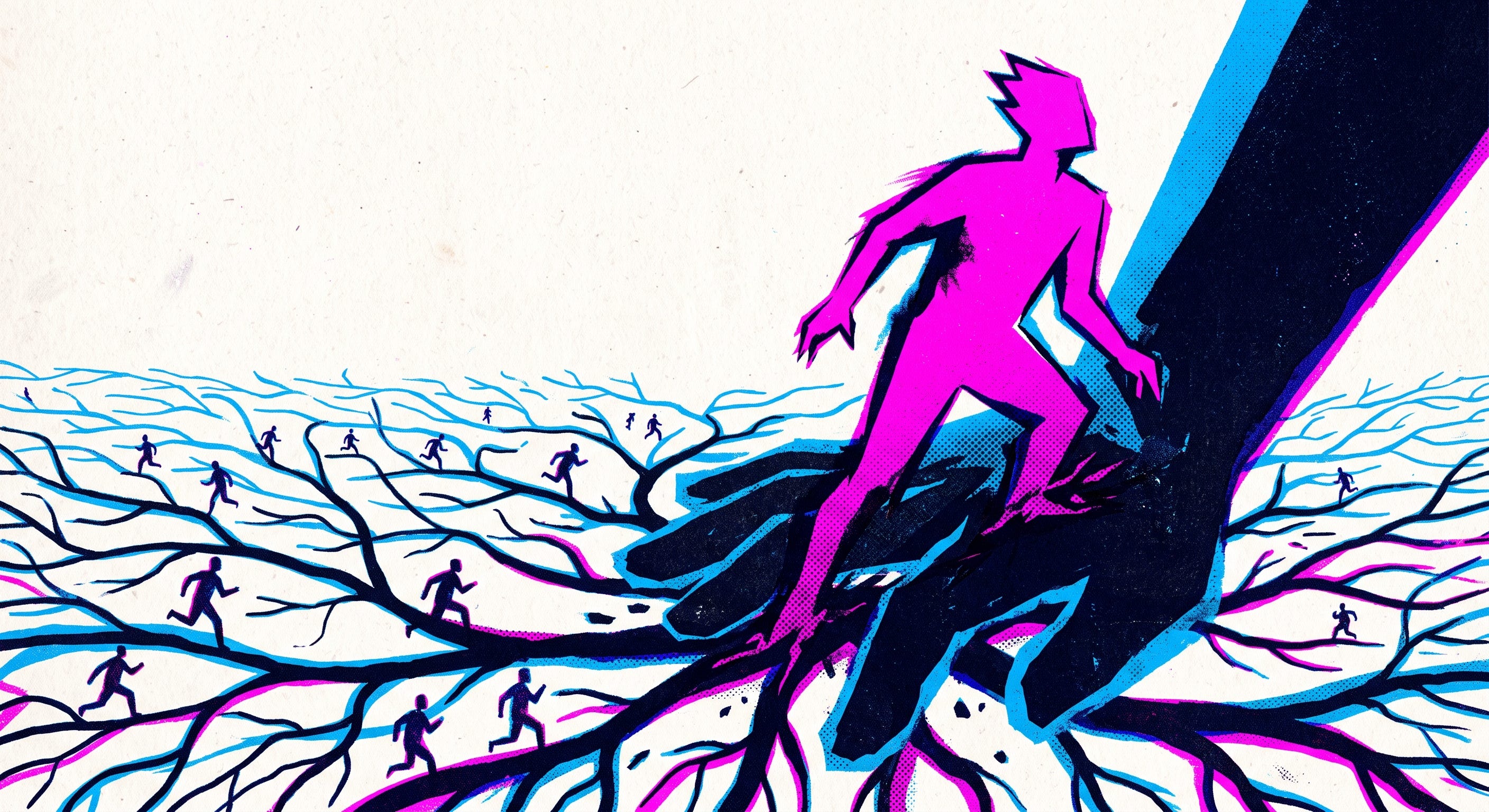
A 13th-century Franciscan friar named Duns Scotus had a word for the part that is the whole story. He called it quiddity — from quidditas, “whatness.” Quiddity is what makes you human at all: the shared substrate, the species-level pattern, the thing you have in common with eight billion other mammals walking around on two legs. Every one of us runs on it. It’s the operating system.
Then he named the other thing. Haecceity — from haecceitas, “thisness.” Not what you are, but that you are this one, and never again. Not a rarer instance of the pattern. Not even the best instance. A different category of fact altogether — a non-negotiable, non-repeating, non-transferable this. Scotus insisted it wasn’t made of qualities at all. You can list every trait you have — kind, funny, tall, anxious, generous — hand that list to someone else, and none of it is what makes you you. Thisness sits underneath the list. It’s not a better description. It’s the fact that there’s a someone there to describe in the first place.
Every ecosystem on the planet already runs this, and most humans have forgotten it: quiddity and haecceity were never in competition. Look at a mycelial network. Every strand runs on the same shared protocol — nutrient exchange, chemical signaling, the same fungal quiddity threading through the whole forest floor. And every strand still grows into a shape no other strand will ever grow into again, reaching toward light and water that exist nowhere else, in a configuration the forest will only get once. The pattern doesn’t erase the particular instance. The particular instance is how the pattern gets to happen at all. Life doesn’t choose between the universal and the unrepeatable. It runs on both, simultaneously, without noticing the philosophical problem we’ve made out of it.
I wrote once that the spirit is the essence of a person, and that this essence gets more refined and more pronounced with the individual evolution of consciousness. I didn’t have the Latin for it back then. I do now. Quiddity is the spirit you were issued. Haecceity is what it looks like once you’ve actually lived in it long enough to sharpen it into a shape nobody else could have made.
Most people never get there, and it’s not because they’re lazy. It’s because standing out registers, deep in the nervous system, as a threat. Fear of individuality is a real, nameable fear — the anxiety of being different enough that the tribe might not catch you if you fall. So people flatten. They perform the socially rewarded version of themselves, keep the edges sanded off, trade their one unrepeatable shape for a slightly more popular counterfeit. Congratulations, you’re now extremely relatable. You’re also nobody in particular.
And don’t mistake the opposite failure for freedom. Haecceity with no quiddity underneath it isn’t individuality — it’s the attention economy’s real product: audiences of one, each fed a personally optimized reality until nobody can find common ground with anybody else, each self-declared main character starring in a story no one else was cast in. That’s not thisness. That’s isolation wearing thisness as a costume.
The actual work was never “discover your essence” like it’s buried treasure with a fixed X on the map. You don’t come with a core. You come with the raw shared material and an entire lifetime to press it, unrepeatably, into a shape. Nobody else on this planet — not one of the several billion running the exact same human quiddity — will ever produce your particular thisness. Not because you’re better. Because the universe genuinely does not do reruns.
So be the mammal. And then, for God’s sake, be the one it will only make once.