

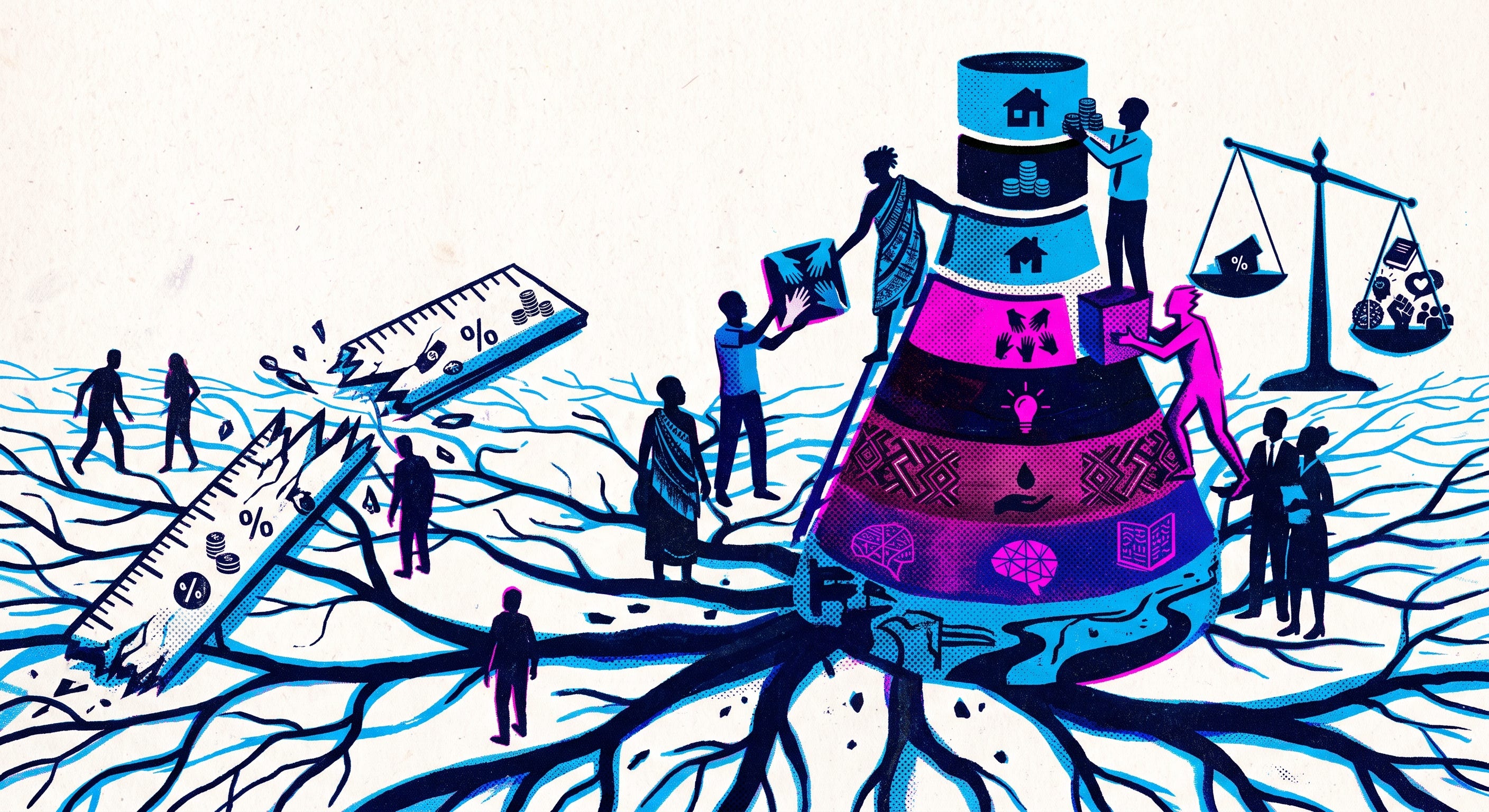
In February 2021 I published a short piece on Medium making a simple claim: the way we measure value and wealth is broken, and I could sketch a better way on a single page.
Four and a half years later, that sketch has been the working core of a citizen council in Germany, it has become a central element of an initiatve in Germany— and in Kenya it led us to farming communities whose traditions had beaten us to the idea by generations.
Time for an update:
1 - The numbers haven’t gotten less obscene
Back then I wrote: 8.6% of humanity hold 85.6% of the financial capital on this planet. 29.9% hold 97.2%. Which leaves seven billion people holding, essentially, nothing.
You can update the decimals — wealth concentration has only accelerated since — but the shape of the obscenity is stable. Our measurement system declares seven billion people worthless. Not poor. Worthless — as in: the instrument we use to measure worth returns zero when pointed at them.
When your measuring stick produces a result like that, the interesting question is not “how do we redistribute?” The interesting question is: what the hell is wrong with the stick?
2 - The stick measures one thing out of eight
Take Maslow’s five dimensions of human need — physiological, safety, love and belonging, esteem, self-actualization. True wealth means feeling subjectively wealthy in all five. Not in a spreadsheet. In your own felt experience. There cannot be any lesser goal than a world in which every human feels wealthy in all five dimensions!
Now ask what inputs produce that wealth, and you arrive at eight distinct forms of capital — I use Soloviev (formerly Roland) and Landua’s model: financial, material, living, cultural, social, spiritual, intellectual, experiential. (i like those, but they are not the only framework!)
Eight forms. Our entire civilization measures exactly one of them — and it happens to be the most abstract of the lot. Financial capital is a claim on the other seven, a pointer, an IOU written against real things. It feeds no one, shelters no one, loves no one. And yet we’ve organized the whole molochian shitshow around maximizing the pointer while liquidating the things it points at.
As I wrote in “Composting Money”: money in its current form is a claim on lost life. The Capital Value Map was my attempt, back in 2021, to draw the alternative — organize the eight forms by their level of abstraction, weight the concrete above the abstract, and watch the ranking invert. Financial capital lands dead last. Social capital rises to the top.
A map is a nice thing. But a map that nobody navigates by is an ornament.
3 - How to actually use it
The process is simple enough to run by yourself, with your family, your team, or your whole community:
Identify how you — or your group — view a truly good life and a truly good world. Not the life you think you’re supposed to want. The one you actually want. LUCID, a process we developed exactly for this, helps with that.
Map the inputs you need to fulfil this idea of a truly good life onto the eight forms of capital. As mentioned, we use Soloviev and Landua’s model; if a different one serves you better, use that.
Explore the result. There is a spreadsheet you can copy and play with. (that was back in 2021 - today you might use LLMs to do that for you)
What most people discover in step 2 is the point of the whole exercise: nearly everything a truly good life runs on turns out to be non-financial. The money was never the wealth. It was, at best, one input among eight — and usually the least interesting one. For me, the finance piece makes up around 7% of my overall definition of wealth.
4 - What happened since: the map got users
Two things happened that I could not have written in 2021, because they hadn’t happened yet.
First: my partner in crime Sebastian Fittko took the framework and built it into the working core of the Initiative Regenerative Marktwirtschaft — the organisation we created to give Germany a path toward a regenerative market economy. Inside the IRM, the multi-capital perspective is not a thought experiment. It is the communication tool, the onboarding tool, the daily working instrument. It sits underneath “New Wohlstand” — New Prosperity — the citizen council through which people redefine, together, what wealth should mean: quality of life, social cohesion, ecological regeneration. The sovereign defining the goal, so politics can fight about the path instead of the destination. Regular readers will recognize this move from “You Are Sovereign. Are You?”
Second: together with Sebastian and Diana, we took the framework into MOTHERLAND, our organisation working with farming communities in Siaya County, Kenya. There it grew into a design I find genuinely beautiful: the Gross Community Product.
The GCP is what happens when you stop asking “how much money moved through this community?” and start asking “is this community actually thriving?” It splits the eight forms of capital along their true fault line. Three are scarce — financial, material, living — and you can measure them objectively: does the community have what it needs to thrive, now and in the foreseeable future? Five are abundant — social, intellectual, spiritual, experiential, cultural — and those you don’t measure from outside at all. The community members assess them subjectively, themselves, because subjective felt wealth was the whole point from the beginning.
Then you weight it: 80% abundant, 20% scarce.
That is the exact inversion of GDP. The forms of capital that grow when shared — knowledge, trust, culture, spirit, experience — carry four times the weight of the forms you can hoard. The measurement itself teaches the economics.
In full honesty i have to say that we have not yet succeeded in implementing the GCP on the ground. It remains work in progress, and I will report as it unfolds. But while trying, we stumbled into something better than validation. The farming communities we work with have been practicing old knowledge — passed down, lived, never written into any economics textbook — that runs on remarkably similar ideas: wealth assessed by the community, in the currencies of relationship, knowledge, and shared life, with money as one small input among many. We didn’t bring them a new measurement. We brought a formalization of something their traditions already knew.
5 - The questions, four years later
I ended the 2021 piece with three questions to the privileged — do we find the courage to convert our financial capital into the other forms, do we let go of the power we think we hold, do we break free of the current model of measuring value.
I’m no longer asking whether it can be done. Farming communities in Kenya have been living a version of it for generations, without waiting for anyone’s framework. A citizen council in one of the largest economies on Earth has been negotiating New Prosperity in public. And in between, we are doing the slow, unglamorous work of turning a map into an instrument.
So the questions have sharpened into one:
The stick is broken. The replacement is older than the stick, and it is being rebuilt in public, right now.
What are we waiting for?