Robin Dunbar sat before primate data in the early 1990s. Neocortex size on one axis, social group size on the other. Chimpanzees live in groups of about fifty. Baboons about eighty. Extrapolate the curve for humans and a number comes out that surprised even him: one hundred and fifty.
He tested it against hunter-gatherer bands, medieval villages, military companies, Hutterite communities that deliberately split when they cross that line. The number held. Later research refined it into shells: five closest confidants, fifteen close relationships, fifty regular contacts, one hundred and fifty stable acquaintances. Beyond that, faces, names, loose threads.
These are not arbitrary. They are the geometry of our sociality, and they carry a hard implication. If we can only hold a limited number of stable relationships, then coordination at scale cannot be flat. It needs layers.
Two other thresholds reinforce this. Richard Frankham’s work in population genetics gave us the 50/500 rule: below fifty individuals a population suffers inbreeding, below five hundred it loses long-term adaptability. Bettencourt’s urban scaling laws show that above roughly five thousand inhabitants a settlement tips into a qualitatively different dynamic. Three empirical thresholds converge on the same demand: not one layer but six.
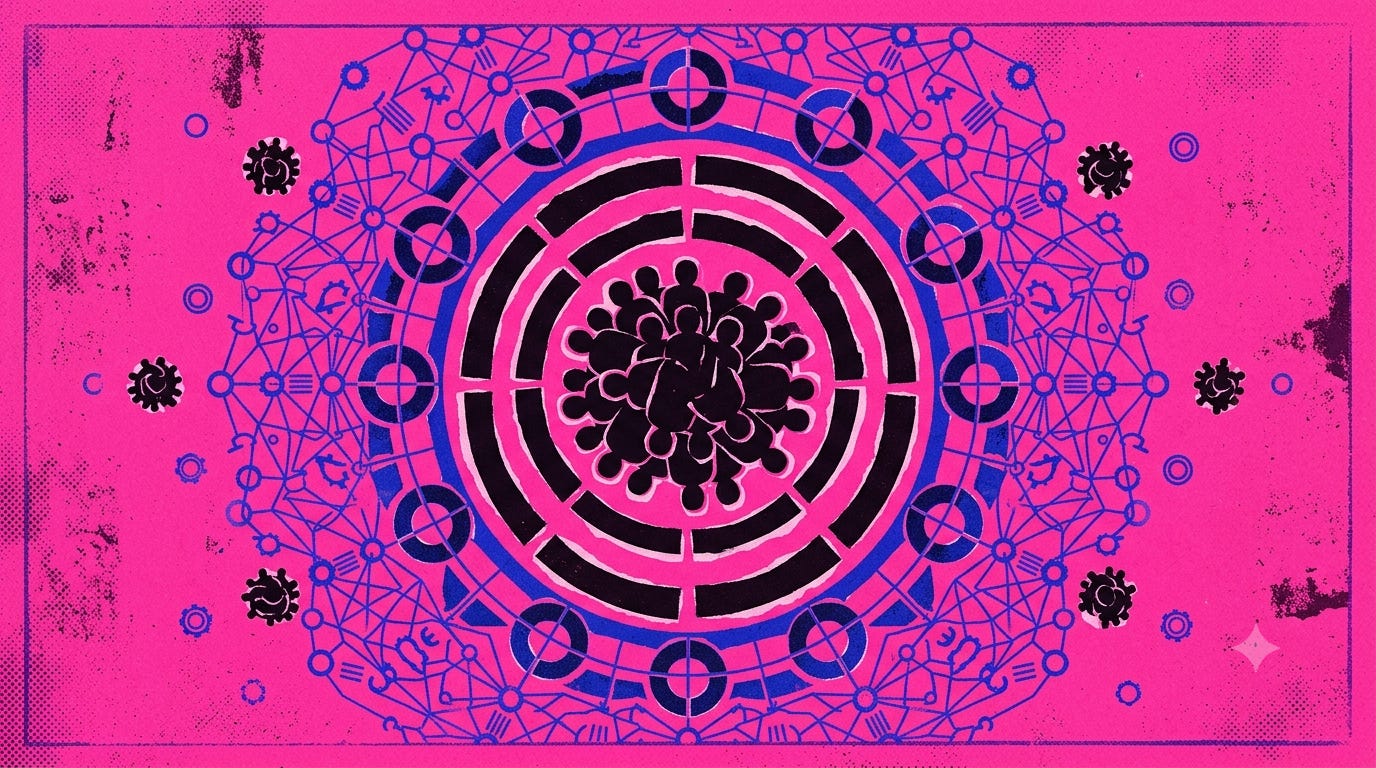
The cell: six to sixteen people. The order of magnitude of the closest relationships. Consensus carries here, because every voice has room and blockage harms the blocker too. The Quakers have practised this since the seventeenth century.
The pod: fifteen to fifty. Consensus no longer carries. Instead sociocracy takes over, a procedure where a decision passes so long as no one has a serious objection, not “I dislike this” but “this does real harm.” Gerard Endenburg systematised it in the 1970s, building on Kees Boeke’s older Dutch experiments.
The guild: fifty to one hundred and fifty. Dunbar’s number. Sociocracy continues but is enriched by the first commons structures. Shared resources need rules. Ostrom’s eight principles begin to carry here: clear boundaries, local adaptation, collective choice, monitoring, graduated sanctions, conflict resolution, recognition of self-organisation, polycentric embedding.
The civium: five hundred to fifteen hundred. Frankham’s lower bound, large enough for genetic and cultural reproduction, small enough for cohesion. Various pods and guilds weave together. Citizens’ councils and participatory budgets find their natural home on this layer.
The federation: several civia bound by treaty. No binding authority over its members. It proposes, coordinates, suggests standards. Membership is voluntary.
The planetary commons: knowledge, designs, standards, protocols that belong to no one and are available to all. No governance in the classical sense. Only care.
This geometry reverses the axis we are used to from the nation-state. In the nation-state, authority is strongest at a distance. The constitution stands above federal law above state law above municipal statute. In the heliogenic model, authority is strongest up close and fades outward. The federation can only propose. The planetary commons can only offer.
What flows the other way is information. Narrow at the near layers, few people with few topics. Wide at the distant layers, millions of people with billions of bodies of knowledge. The near layer has no overview but knows its own things deeply. The distant layer has overview but knows no details.
Each layer has its own governance. Consensus only in the cell. Sociocracy in pod and guild. Ostrom’s principles from the guild upward. Treaty federation beyond that. Planetary commons managed by soft conventions and care. The centralising pathology of the nation-state is prevented by making it structurally impossible for a more distant layer to compel a nearer one.
This is not a theoretical construct. Mondragón has been running on a similar architecture since 1956. Founded by a Catholic priest in the Spanish Basque Country, it is now the largest cooperative federation in Europe: over ninety-six thousand employees, revenues above eleven billion euros. Individual cooperatives of a few dozen to a few thousand workers, each democratically governed. Sectors that coordinate without commanding. A federation that offers services, a shared bank, a shared university, a shared research arm, without compelling any of its members. It has survived dictatorship, globalisation, financial crises, and the bankruptcy of one of its largest members. Almost seventy years.
The thinkers behind this layered model, Forrest Landry, Daniel Schmachtenberger, Jordan Hall, work from different traditions but converge on the same architecture. Landry argued from systems theory that every living system reverses the authority axis. Schmachtenberger described a generator function of existential risk built into hierarchical architectures. Hall called the alternatives Game A and Game B, competition versus cooperation, growth versus flourishing.
Critical questions remain. Does it scale? The answer lies in the separation of layers. Five million civia do not negotiate pairwise. They coordinate through shared commons. A civium setting up a participatory budget does not need to talk to one in India. It uses Decidim, which is openly available, and adapts it locally. The commons does the coordination indirectly.
What prevents harm between civia? Treaty mechanisms for conflict resolution, and for genuinely planetary problems, climate, pandemics, nuclear weapons, coordination through protocols and international agreements. This is not guaranteed. It is a condition of civilisation.
Then the model finds its organisational mirror. The Internet Engineering Task Force has run the internet for decades on a principle captured by David Clark in 1992: we reject kings, presidents and voting. We believe in rough consensus and running code. The IETF has no membership, no headquarters, no binding authority. It issues Requests for Comments, technical documents anyone can implement or ignore. IP, TCP, HTTP: none of these were commanded. They were proposed, debated, tested, adopted because they work. The central design decision is end-to-end: the network stays dumb, intelligence sits with the users. Innovation happens at the edges without permission.
This is the heliogenic discipline: more distant layers issue protocols, not commands. A federation of civia gets standards for food databases, energy exchange, knowledge documentation from the planetary commons. No one compels a single civium to use them. But whoever does has immediate access to everyone else who does, and to their collective experience. Connection without compulsion. Network without centre.
to read the full series in English go to

um die ganze Serie auf Deutsch zu lesen: