

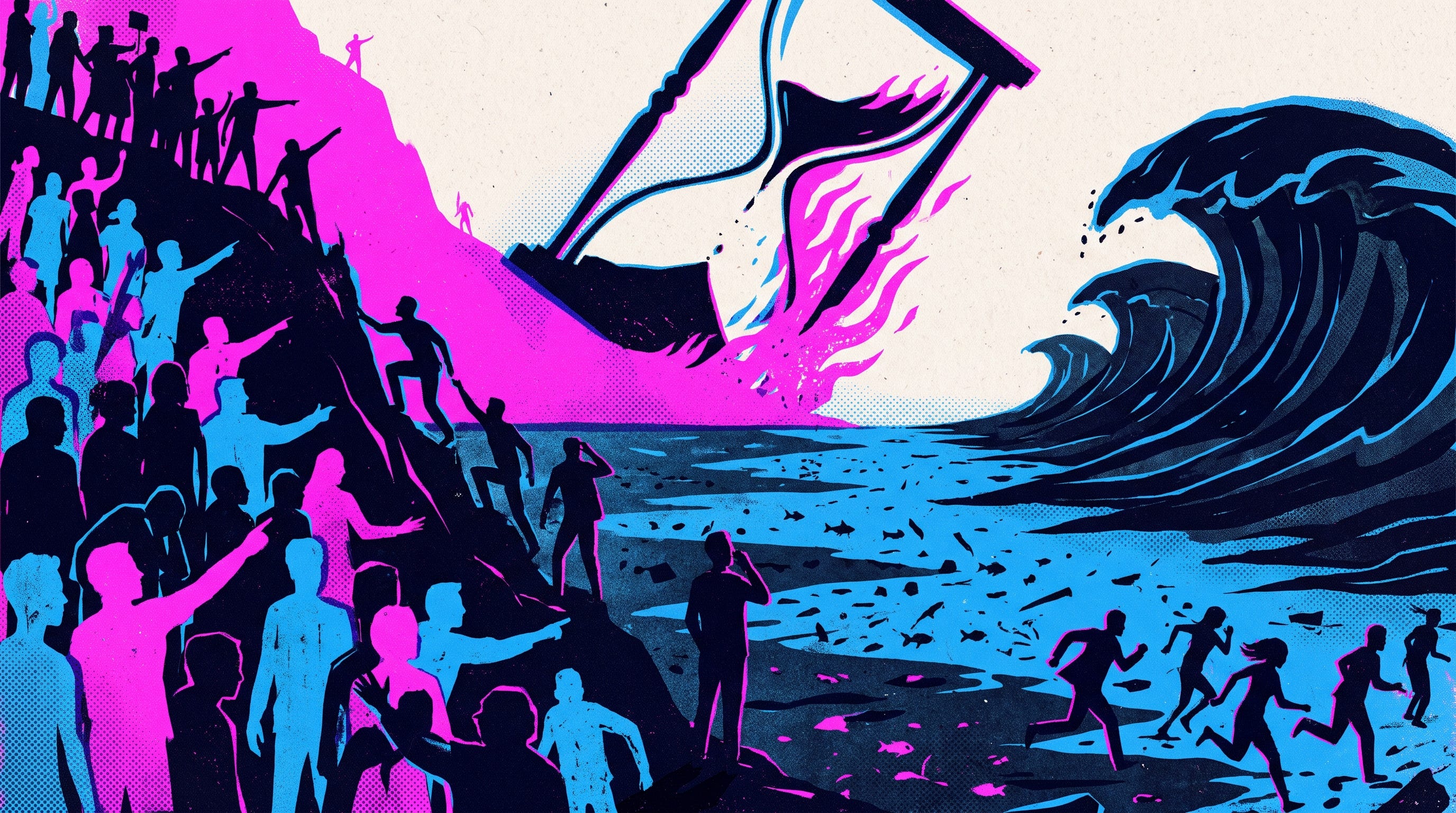
26 December 2004, a beach on the Andaman coast of Thailand. Shortly after ten in the morning the sea went out. Not with the tide. All at once, hundreds of metres, and it stayed out. Fish lay flapping on the wet sand. People walked out to look. Some took photographs. Some picked up the fish.
A tsunami is not one wave. It is a train of them, and when the trough of the first reaches the shore before its crest, the sea retreats. On Phuket that morning it stayed away for five to ten minutes. The retreat is the only warning the ocean gives. It is also the last window in which running works.
Krisis
Krisis, in Greek, is the moment of decision. Hippocrates used it for the hour a fever turns, when the patient will recover or die and nothing has been settled yet. Edgar Morin welded poly onto it in 1993, Jean-Claude Juncker borrowed it for the EU in 2016, Adam Tooze put it in the Financial Times on 28 October 2022, and that January Davos printed it in the Global Risks Report. I have used it myself, in the Motherland post and in the Miracle Factory one.
Polycrisis was the right word. For the retreat.
Pandemic, war, inflation, a heat record every summer. Each one filed as a crisis, each one managed, each one followed by a walk back down to the beach. And the exposed seabed was full of fish. Money at zero percent. Flights for 29 euros. A machine that writes your emails. We walked out and picked them up.
You did. So did i.
The people paid to know have left the beach
Watch who runs. In May 2023 State Farm stopped writing new home policies in California. In 2024 it dropped some thirty thousand existing ones, concentrated in the zip codes most likely to burn. Allstate, Hartford and a row of smaller carriers did the same in California and Florida. An insurer is a company whose entire job is to price the next fifteen years. When it refuses to price them at any premium, it has done the sum and gone uphill.
2024 was the first calendar year more than 1.5 degrees above pre-industrial. James Hansen puts Earth’s energy imbalance at roughly double what it was in the early 2000s. That is the crest, and you can see it from the sand.
Katastrophē is the other Greek word. The overturning. In the theatre it is the turn after which the plot can only run down. Nobody decides anything during the catastrophe. The deciding was the krisis, and it is behind us.
The polycrisis is over. Welcome to the polycatastrophe.
Tilly Smith, ten years old, from Surrey, saw the water froth and run out at Mai Khao beach and remembered a geography lesson from two weeks earlier. Her parents argued with her for a minute, then ran, and took about a hundred people with them. Mai Khao was one of the few beaches on Phuket with no dead.
Simeulue is the inhabited island nearest the epicentre. In 1907 a tsunami killed more than half its people. The survivors put what they had learned into a lullaby, and the lullaby has a name, smong: when the earth shakes and the sea runs away, leave everything and climb. On 26 December 2004 the island had 78,000 people. Seven died.
The Moken on the Surin islands have a word for it too, laboon, the wave that eats people, told around fires for generations. When the sea pulled back, the elders shouted it, and the villages were empty before the wave reached them. Not one Moken died.
The Indian Ocean had no warning system in 2004. The Pacific centre in Hawaii saw the earthquake, knew what it meant, and had nobody to call. The three groups who lived had something smaller than a warning system: a sentence short enough to fit in a lullaby, and people who moved when one of them said run.
We wrote in Weltaufgang that the world would not end with a bang but with a whisper we didn’t notice. The whisper was the sound of the sea going out.
There is nothing left to decide about the wave. What remains to decide is who is standing next to you, how far your hill is from the beach, and whether the sentence that gets you there is short enough to shout.
Uphill.