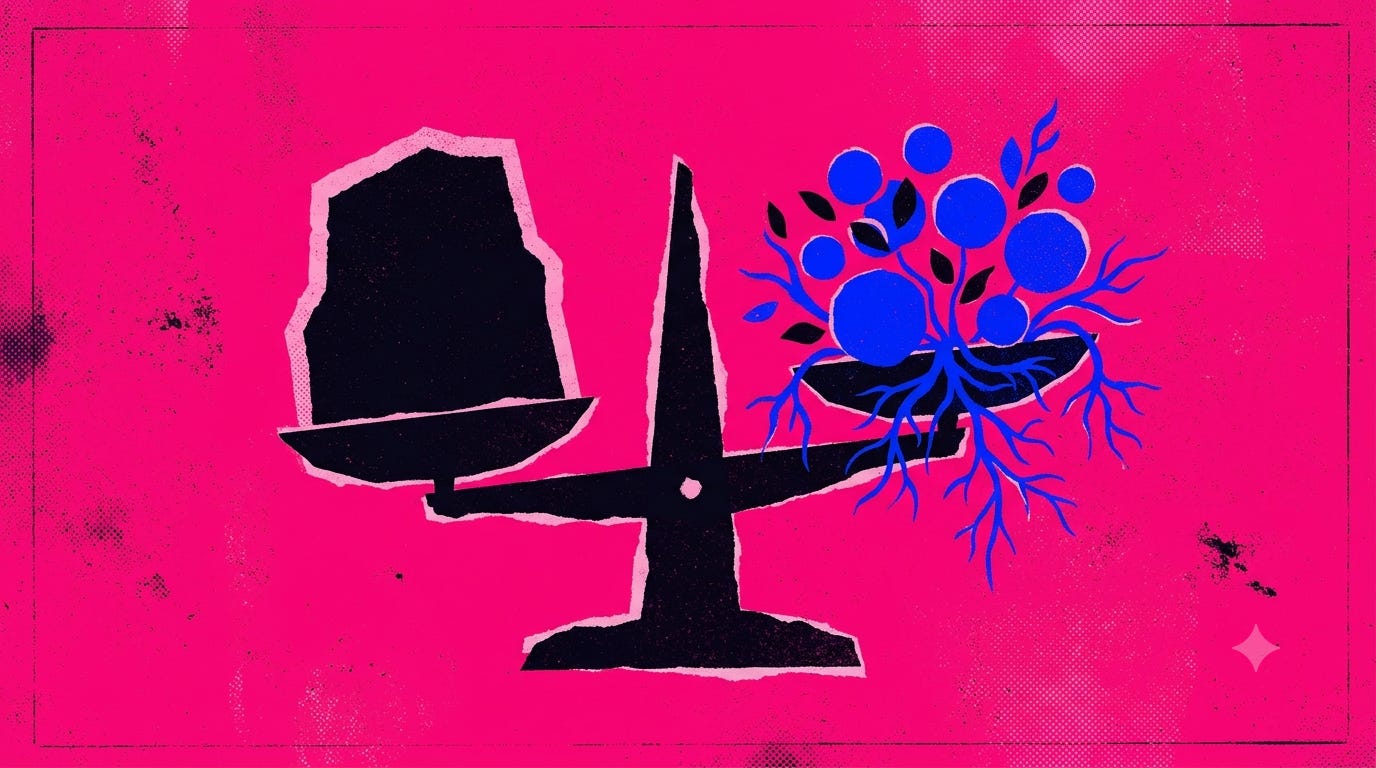
Basel, 1934. Sixteen business owners sit in a back room. The Swiss franc is scarce, credit from banks scarcer still. They agree to accept each other’s promises at a fixed rate: one WIR equals one franc, but these WIR circulate only among them, cannot earn interest, cannot be withdrawn to a Swiss bank. They can only move from hand to hand, building what the national currency could not. Nearly a century later the WIR network links over sixty thousand businesses and moves two billion francs a year. It never replaced the franc. It grew beside it, another layer.
Bernard Lietaer spent decades on this idea. He co-designed the ECU that became the euro, worked inside central banks, taught at Berkeley, and over the years became one of the sharpest critics of the architecture he helped build. His answer was a multi-currency ecology. Global lead currencies for trade, regional currencies for local circuits, complementary currencies for care and education, time currencies for neighbourhood exchanges. The Chiemgauer has circulated in Bavaria since 2003. Banco Palmas in Brazil since 1998. Hundreds of time banks operate worldwide. None will replace the dollar or the euro. The point is to make it structurally impossible for a single monetary power to control everything.
The same logic runs through knowledge. What Linux, Wikipedia and Decidim share can be done anywhere many people must develop and use knowledge together. Most seed varieties now belong to three corporations. The Open Source Seed Initiative has kept varieties freely accessible since 2014 under a pledge: every new variety bred from them stays open. DNDi develops drugs for neglected diseases outside the patent system, public domain, producible by any government. Open Source Ecology publishes construction plans for fifty essential machines, build locally, pay no licences. WikiHouse publishes open building plans that can be cut with local woodworking tools. The principle: knowledge not enclosed but kept open. Anyone may use it. Anyone who improves it gives the improvement back. These commons form the spine of the architecture. They let the local succeed without reinventing everything from scratch.
Elinor Ostrom spent her career documenting functioning commons: irrigation systems in Spain and the Philippines lasting centuries, alpine pastures in Switzerland, fishery commons in Maine. She extracted eight principles that recur wherever commons endure, clear boundaries, local adaptation, collective choice, monitoring, graduated sanctions, conflict resolution, recognition of self-organisation, polycentric embedding. She dismantled the thesis that commons must inevitably be overused by showing that most real commons carry rules their users developed themselves.
The third safeguard is diagnostic. An architecture that answers to no single authority needs tools that let it see whether a technology, an institution, an expansion still serves what it was built for. Ivan Illich named conviviality: the property of a tool to strengthen autonomy rather than weaken it. Tools have a right size. A school below a certain threshold fosters learning, above it hinders. A hospital below a certain threshold heals, above it makes sick. The thresholds are empirical, the principle is that tools overshoot.
Tyson Yunkaporta gave the distinction between growth and deepening. The West knows one answer: make it bigger. Indigenous traditions know another: deepen the relationship. If your connection to the forest is shallow, go deeper, do not plant more forests. If your family is coming apart, deepen the bonds you have, do not enlarge the family. A civium that solves its difficulties through more members, more money, more activity walks the old path. One that solves them through better relationships, better care for local resources, walks the heliogenic path.
Iain McGilchrist described the two hemispheres as master and emissary. The right perceives the whole, in context, in depth. The left breaks into parts, abstracts, controls. Today’s civilisation has a left-hemisphere pathology: the measurable triumphs over the experienced, efficiency over beauty. The lens allows a permanent question: which hemisphere dominates in this institution, this technology?
These instruments are not ornaments. A city council considers enlarging its participatory budget: does the procedure become so large that connection among participants is lost? Would fewer topics, worked more intensively, achieve more? Do we lose, in measurable indicators, what cannot be measured, the pride, the connectedness? A cooperative considers a new digital platform: does the tool make members more autonomous or more dependent? Do we lose, in clicks and likes, the silence, the conversation between the lines? These questions are the price of an architecture no one compels.
The discipline can fail. A civium takes from the planet’s commons without giving back, uses Linux, Wikipedia, open-source seed, returns nothing. Legal. But if all did this the commons would wither. A federation tries to compel its members. The temptation lives in every growing organisation. A multi-currency ecology tips back toward single-currency dominance. The architecture is not self-sustaining. What protects it is not a mechanism but a discipline each generation must achieve anew.
Behind this discipline stand minds. Spring 2020: a man sits before a wall of books. Daniel Schmachtenberger speaks for two hours about generator functions of existential risk, properties built into civilisation that produce nuclear threats, ecological crises, social polarisation. Three million views. His argument: these risks share common causes, multipolar traps where individually rational decisions become collectively destructive, acceleration that outruns understanding. To remedy them demands a re-architecting of the whole.
Forrest Landry built a metaphysics he calls Immanent Metaphysics, three irreducible dimensions, matter, relationship, meaning. Classical science reduces everything to matter, religion to meaning. Both create pathology. Living systems, Landry argues, have an architecture in which distant layers support the near ones, never compel them. His most effective work is a twelve-episode conversation with Jim Rutt in 2020.
Jordan Hall gave the movement a vocabulary. Game A: competition, growth, hierarchy. Game B: cooperation, flourishing, multi-layered organisation. It is not the opposite, just a different architecture. Once you have the distinction, you can describe what is and what could be without old camps.
John Vervaeke asked not how civilisation should be structured but what happens to people when the structures fail. His fifty-part lecture from 2019 traces the Western search for meaning from Socrates to the present. Four paths of knowing sustain a healthy human existence: propositional, procedural, perspectival, participatory. The modern world privileges the first, starves the fourth. An architecture that counts only the measurable cannot carry the connected.
Michel Bauwens bound the currents together through the P2P Foundation. Open-source, commons economy, cooperative movement woven into Commons Transition. Market dominates, state serves, commons is marginalised. He proposes reversing that order. His foundation accompanies pilot projects worldwide.
Seven thinkers, seven approaches. None came through slogans. Each worked for years, some for decades. Vervaeke’s series is sixty hours, Ostrom’s book two hundred and forty pages of dense argument, Schmachtenberger’s lectures two hours unedited. The depth is part of the message.
to read the full series in English go to

um die ganze Serie auf Deutsch zu lesen: