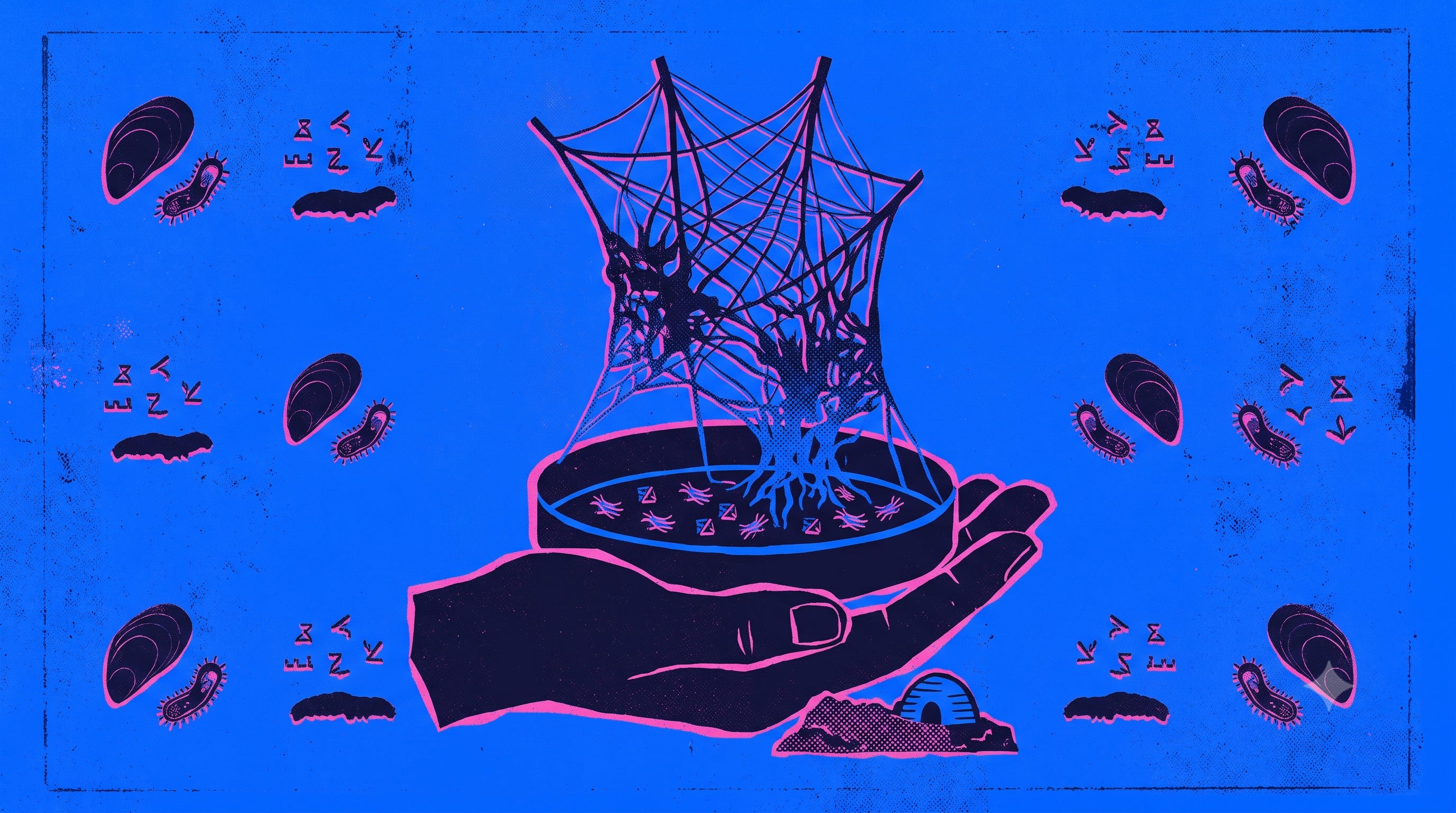
Wood and grass are the plant materials. The serial then moves down, into the soil.
Mycelium is the vegetative network of a fungus: the fine white threads that wind through everything under the forest floor, not the cap you see above ground. The largest known organism on Earth is a single honey fungus in Oregon, ninety square kilometres of continuous living thread. Mycelium is light, firm, insulating, water-resistant. You can grow it on sawdust and coffee grounds, and after a short growth phase you dry it and it becomes a dense, rigid material that replaces polystyrene and composts in your garden.
Ecovative Design has been doing this commercially since 2007. IKEA uses their mycelium packaging. Bolt Threads grows Mylo, a leather substitute from the same stuff, and Adidas, Stella McCartney and Lululemon have built products from it. MycoWorks supplies Hermès. A pavilion made entirely of mycelium bricks stood in the courtyard of MoMA PS1 in 2014. These are not experiments. They are shipments.
But mycelium leads somewhere wider. It leads to the question of what happens when you stop looking at materials as things you melt and start looking at them as things you programme.
Anne Meyer was walking a beach on Cape Cod in 2010 when she picked up a mussel and really looked at it for the first time. Mother-of-pearl is aragonite platelets interspersed with organic proteins, microscopically layered, three hundred times harder than the pure mineral, lighter than steel. The mussel pulls calcium ions from seawater and deposits them on a protein template, layer by layer, at ambient temperature and pressure. No blast furnace. No mine.
Meyer asked a different question than most. Not: how does the mussel do this? But: can we build the same instructions into bacteria, which are easier to grow than mussels? Today her lab at Rochester programmes bacteria to produce materials with deliberately tuneable properties: conductive, transparent, flexible, magnetic. She has bacteria that lay down cellulose with embedded conductive polymers. Bacteria that place iron-oxide particles precisely, yielding a magnetic material you can shape on demand. These are demonstrations, not products. But they show what becomes possible when you treat the procedures of Life as programmable.
At the other end of the resolution scale sits Neri Oxman. Her Silk Pavilion used six thousand five hundred silkworms guided by light conditions to spin a structure no industrial fabric could match. Her Aguahoja pavilion was built entirely from cellulose, chitin and pectin, the three most common biopolymers on Earth, and composted after the exhibition. Her method, which she calls Material Ecology, treats form and substance as inseparable: the material’s properties emerge on site, through growing or printing or biological assembly.
Meanwhile Spiber, in Japan, has been producing spider-silk proteins from engineered bacteria since 2007. They call it Brewed Protein. The North Face has sold jackets made from it. A production plant in Thailand now runs at hundreds of tonnes per year. Spiber solved the problem spiders themselves pose, they eat each other in captivity, by side-stepping the spider entirely and going straight to the genes. Modern Meadow does something similar for leather: yeast ferment collagen, which is processed into a material that competes with animal hide, without the ten percent of global methane that cattle contribute on the way.
This field has become real faster than most people notice. Investment in synthetic biology crossed twenty billion dollars in 2024. Four-digit company count. Exponentially growing patents. The work that started with Anne Meyer on a beach is now a global industry in formation.
It raises questions Meyer and her peers do not dodge. Biosafety: the risk of programmed microbes escaping is real. The answer today is biocontainment, strains that cannot survive outside the tank, but every new procedure needs its own honest audit. Patenting: since 1980 in the US, living organisms can be owned. An open-source synthetic biology exists, seeded by the iGEM competition, but the industry trends toward closed systems. If these materials are to be part of a shared future, the designs should circulate like Linux, not like a Monsanto seed. And a deeper question about relationship. When you programme a bacterium, you are either mastering it or collaborating with it. Kimmerer writes of indigenous plant breeding carried out in reciprocity: what you take, you give back. Synthetic biology does not yet have that grammar. The field will need to find one.
Then the serial lands on the simplest material of all. Earth.
Schloss Tempelhof, two hours from Stuttgart. An Earthship, half buried in a hill, south-facing glasshouse, walls of old tyres packed with soil and plastered with clay. It heats itself. It catches its own water. It recycles grey water through plants. It took three years just to get the permit. It is the only permitted Earthship in Germany.
This is the strange situation the serial keeps surfacing. Clay building is the oldest way of building on Earth. Çatalhöyük, nine thousand years ago, thousands of inhabitants, entirely of clay. The eleven-storey clay towers of Shibam in Yemen have stood since the sixteenth century. Rammed earth was standard in Central Europe until the twentieth. Clay breathes with the humidity, stores heat impeccably, binds no pollutants, consumes about a hundredth of the energy of concrete per square metre, and can be returned harmlessly to the ground when the building’s life is over. Michael Reynolds has built over two thousand Earthships in more than thirty countries. Nader Khalili’s Superadobe, fabric tubes filled with moist earth layered into earthquake-proof domes, is a UN-recognised emergency shelter standard.
Still, Germany says no. The building regulations, written for steel and concrete, do not have a field for soil. The insurance tables, the fire-protection codes, the professional liability frameworks: none of them expect a wall made of what is under your feet.
And yet the field moves. Bind-X, a Munich startup, sprays microbes onto desert sand. The bacteria secrete enzymes that bind loose grains into solid ground within days. Roads from earth without asphalt. Dune stabilisation without concrete. Pilot projects in the Emirates, Tunisia, Mali.
This is the heliogenic logic in its most distilled form. Instead of hauling material from far-off mines, you activate what is already there. Instead of melting and smelting, you borrow the chemistry life has been refining for three billion years. The question is never the material. The question is the permission.
to read the full series in English go to

um die ganze Serie auf Deutsch zu lesen: