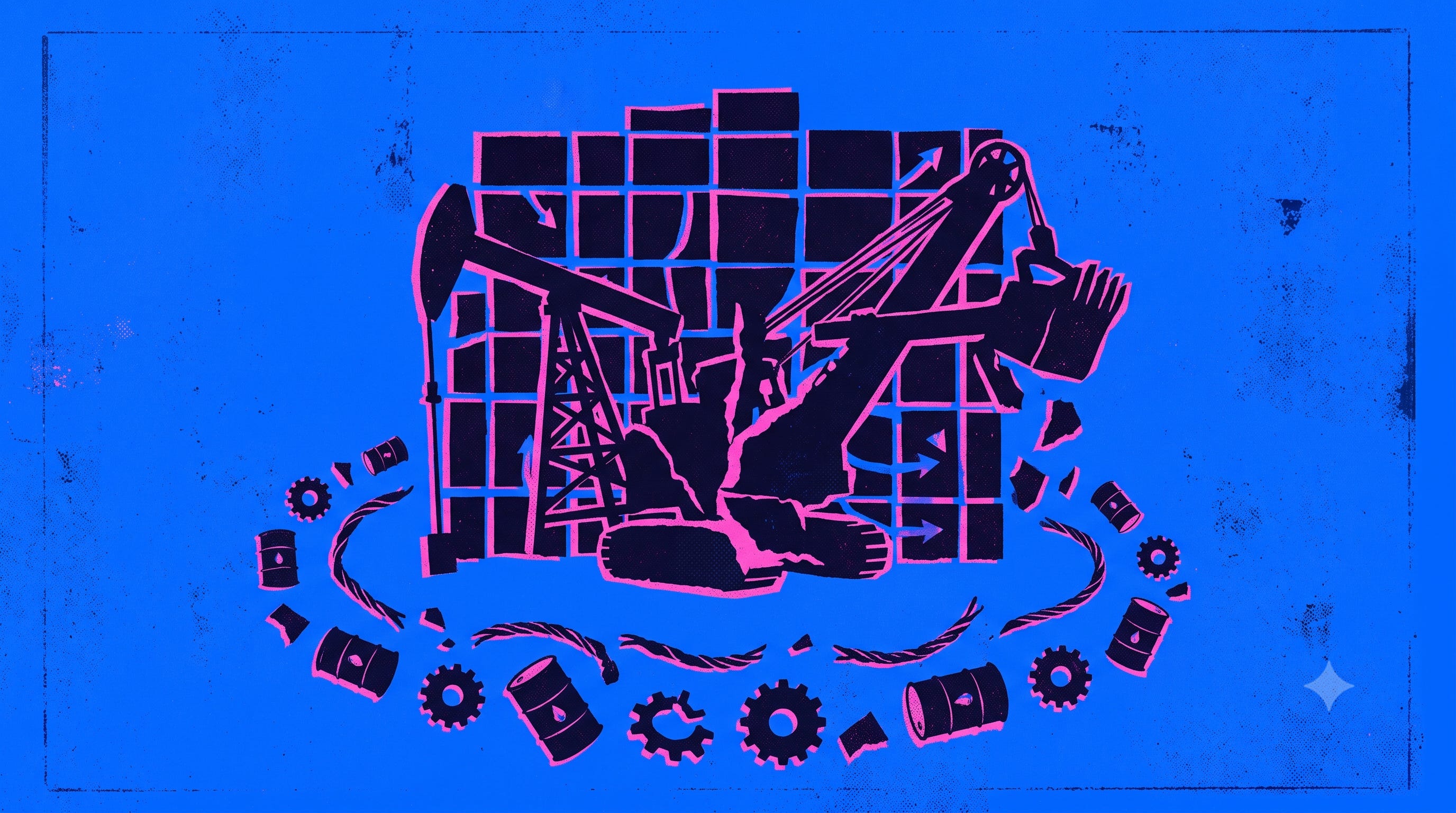
Two design flaws, sitting next to each other. One compels growth. The other lets whoever grows rich from externalising harm buy the rules. Between them they disable the market’s error correction entirely.
This is not metaphor. Gilens and Page demonstrated it for the United States in 2014: subtract the preferences of the economic elite, and the median voter’s influence on legislation vanishes. The curve bends toward whoever paid for the advertising. The machine does not break by accident. It is held broken. Structurally, quietly, with the same plausible deniability any architecture affords its inhabitants.
Which brings us to Spindletop. Texas, January 1901. A drill hits eleven hundred feet and the ground answers with a fountain forty metres high. It stands for nine days before anyone can cap it, spilling a million barrels into the mud. More each day than the whole of the United States was producing.
Nobody at the time used the word battery. But that is what they had found. Sunlight, captured by algae and pressure and millions of years of patience, waiting in the rock like a charge.
We have been draining it since. Eighty-five percent of our civilisation runs on it. And while it drains, the returns diminish. Those first Texan fields gave a hundred units of energy back for every unit invested. Today conventional oil averages about fifteen to one. Tar sands have touched three. Charles Hall, who built this way of counting, reckons a modern society needs at least ten to one to keep its schools, its hospitals, its roads and orchestras alive. Below that threshold a society still has energy. It just begins consuming its own substance.
Same barrel. Same price tag, maybe. A different reality inside.
Now double the wound. While the energy return thins, the exhaust is pushing the atmosphere toward thresholds that ignore our quarterly reports. Greenland ice, the Atlantic circulation, the Amazon: nine tipping elements in the Earth system, several of them wobbling somewhere between 1.5 and 2 degrees of warming. On current trend that is one to two decades away. What we do not prevent now cannot be un-tipped by our grandchildren.
So we reach for the obvious exit. Electrify everything. Panels get cheaper every year. The sun and wind are free.
Then you stand at the rim of Chuquicamata. An open copper pit in Chile, four kilometres long and a full kilometre deep. Fifty years ago a tonne of ore held four percent copper. Today it holds 0.6. Six times the rock, six times the energy, for the same metal. The trucks that crawl out of that pit weigh three hundred tonnes empty and burn twelve thousand litres of diesel a day.
An electric car wants eighty kilograms of copper, four times what a combustion car needs. Simon Michaux did the sums for the Geological Survey of Finland: a one-to-one replacement of the fossil system would require more copper in two decades than humanity has mined in its entire history. Known lithium reserves would not cover even the first generation of electric vehicles. A new mine takes sixteen years from exploratory drill to first delivery.
This is not an argument against renewable energy. It is an argument for honesty about what renewable energy physically demands. The problem is not that the Earth has too little. It is that the way we use her does not scale.
Here the trap closes. On one side, a fossil battery that poisons the sky and returns less each year. On the other, an electrified world whose material appetite exceeds what mining can deliver at the necessary speed. Both dead ends are real. And neither can be wished away by choosing to talk down the problem you find less frightening.
Bernard Lietaer, who helped design the euro and knew the inside of that machine better than almost anyone, left us a sentence worth the wall it hangs on: the money we have is not the only money that could exist. The WIR franc has quietly steadied Swiss small business since 1934. The Chiemgauer loses value if you hoard it, so it circulates six times faster than the euro. Sarafu fed whole districts of Mombasa during the pandemic when the official currency collapsed. Small, all of them. Real.
Reform will not come from the middle of the system. It builds beside it.
But the deeper turn is the question the serial takes next. Maybe the problem was never the energy source. Maybe the problem is an architecture that demands this much energy in the first place. An economy hauling a hundred billion tonnes of material around the planet every year needs a battery. An economy that grows material where it is needed can live on the light that falls anyway. 172,000 terawatts of it, every day, everywhere, free.
The book calls the answer heliogenesis.
to read the full series in English go to

um die ganze Serie auf Deutsch zu lesen: