The only permitted Earthship in Germany sits at Schloss Tempelhof, two hours from Stuttgart. Half buried in a hill, south-facing glasshouse, walls of packed tyres and clay. It heats itself, catches its own water, recycles grey water through a plant wall. It took three years just to get the permit.
Michael Reynolds has built over two thousand of these in more than thirty countries. Nader Khalili’s Superadobe domes, woven from fabric tubes filled with moist earth, withstand earthquakes that flatten concrete houses and carry a UN emergency-shelter standard. Martin Rauch erected the Ricola Herb Centre in Switzerland entirely from rammed earth, a hundred metres long, passively regulating humidity without air conditioning. Anna Heringer won the Aga Khan Award for Architecture with a school of clay and bamboo in Bangladesh. The Earth Institute in Auroville has trained architects from over sixty countries and open-sources all its building plans.
Clay building works. In every climate. At every scale. For thousands of years.
Germany still says no. The building regulations have no field for soil. The insurance tables, fire-protection codes, professional liability frameworks: none of them expect a wall made of what is under your feet. The question the serial keeps returning to is not whether we can. It is whether we permit it to ourselves.
Then the arc of the material section closes with a rule of thumb from Alex Voigt, one of the engineers who built up the German solar industry. Asked how to tell which materials are biologically producible and which are not, he answered without a pause. If my body can do it, we can do it too.
Bone: calcium phosphate and collagen, light, firm, stronger by density than most industrial composites. Tendon: collagen fibres with tensile strength approaching steel. Haemoglobin: iron chemistry that mimics central industrial processes but runs at body temperature in a glass of water. Enzymes: catalysts that replace precious-metal chemistry with ambient-temperature precision. All of it from genetically coded instructions, all of it breaking down into reusable components at end of life.
What the body cannot do matters just as much. Steel at sixteen hundred degrees. Concrete calcined at fourteen hundred and fifty. Semiconductor crystals in cleanrooms. Permanent magnets from rare earths. These remain a domain of classical industry, and an honest heliogenesis does not pretend otherwise. It pushes them back where possible, uses them more sparingly, and produces what remains with green electricity and green hydrogen, in regional cycles, at high recycling rates.
From this material limit the serial pivots into a different register: the intellectual tool kit that got us here.
Glasgow, 1759. Adam Smith at his desk, writing about sympathy and markets in the same breath. Königsberg, same decade. Kant defining Enlightenment as emergence from self-incurred immaturity. New York, 1788. Madison designing a constitution that assumes men are not angels and distributes power accordingly.
Three pillars. Three error corrections, each with its own sensor. The market corrects through price: a bakery that charges too much has no customers, a bakery that charges too little goes under. Democracy corrects through the vote: lose trust, lose office. Science corrects through experiment: a hypothesis that fails the test is discarded. No one has to be right. No one can enforce what cannot be tested. Whoever tries is eventually spat out by the system.
This is the actual achievement of the Enlightenment. Not the republic, not the market economy, not the periodic table. The idea that mistakes must be made recognisable by a mechanism that does not depend on the favour of the powerful.
But every architecture needs care. A correction that is not regularly readjusted goes under. A sensor that is not cleaned measures falsely. And today, to differing degrees, all three corrections are stuttering.
The market correction reverses when two design flaws compound: growth compulsion and limitless accumulation. Externalities do not appear in the price. Whoever pollutes a river and sells cheap wins. Whoever protects the river and prices honestly loses. The signal inverts. Democracy’s correction fails when the voting public is split apart, when media fragmentation turns campaigns into attention-steering rather than judgement-forming, when the topics put to a vote are pre-selected by a narrow stratum. Science’s correction fails when industry finances the research and the replication crisis reveals that almost half of standard psychology experiments cannot be reproduced. Falsification only works when experiments are actually repeated.
None of this means the Enlightenment failed. It means its tools need maintenance. A carbon price is not ideology, it is repair: bringing an externalised cost back into the sensor. Antitrust law is not anti-market, it is market care. Open-access publication and pre-registration of studies are not bureaucracy, they are the cleaning of the lens.
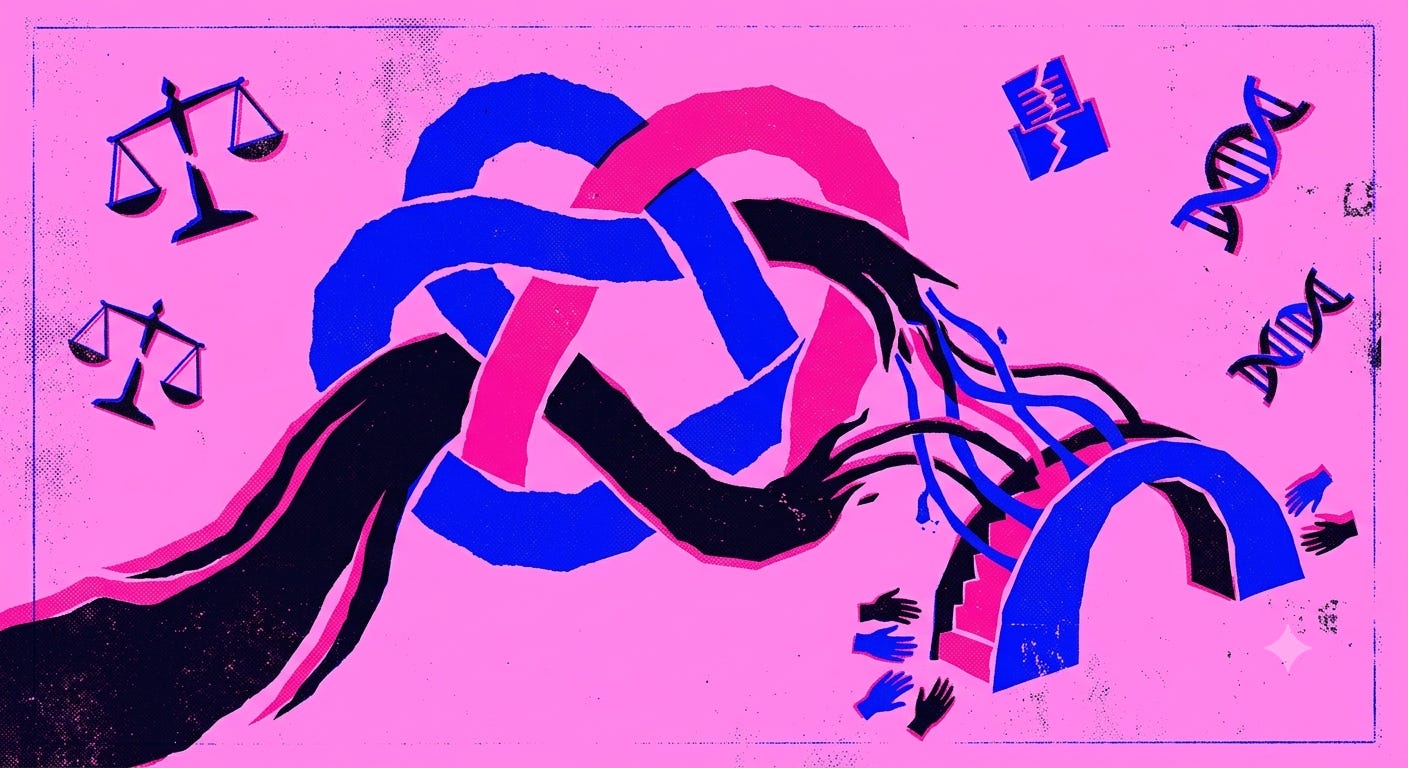
And between the three pillars sits a gap the Enlightenment never fully addressed. The market corrects through price. Democracy corrects through elections every four years. Science corrects through falsification. What happens between elections, how citizens participate in concrete decisions, was never systematically worked out. Citizens’ councils, participatory budgets, deliberative procedures: this is what the second half of the book sets out to supply.
to read the full series in English go to

um die ganze Serie auf Deutsch zu lesen: