

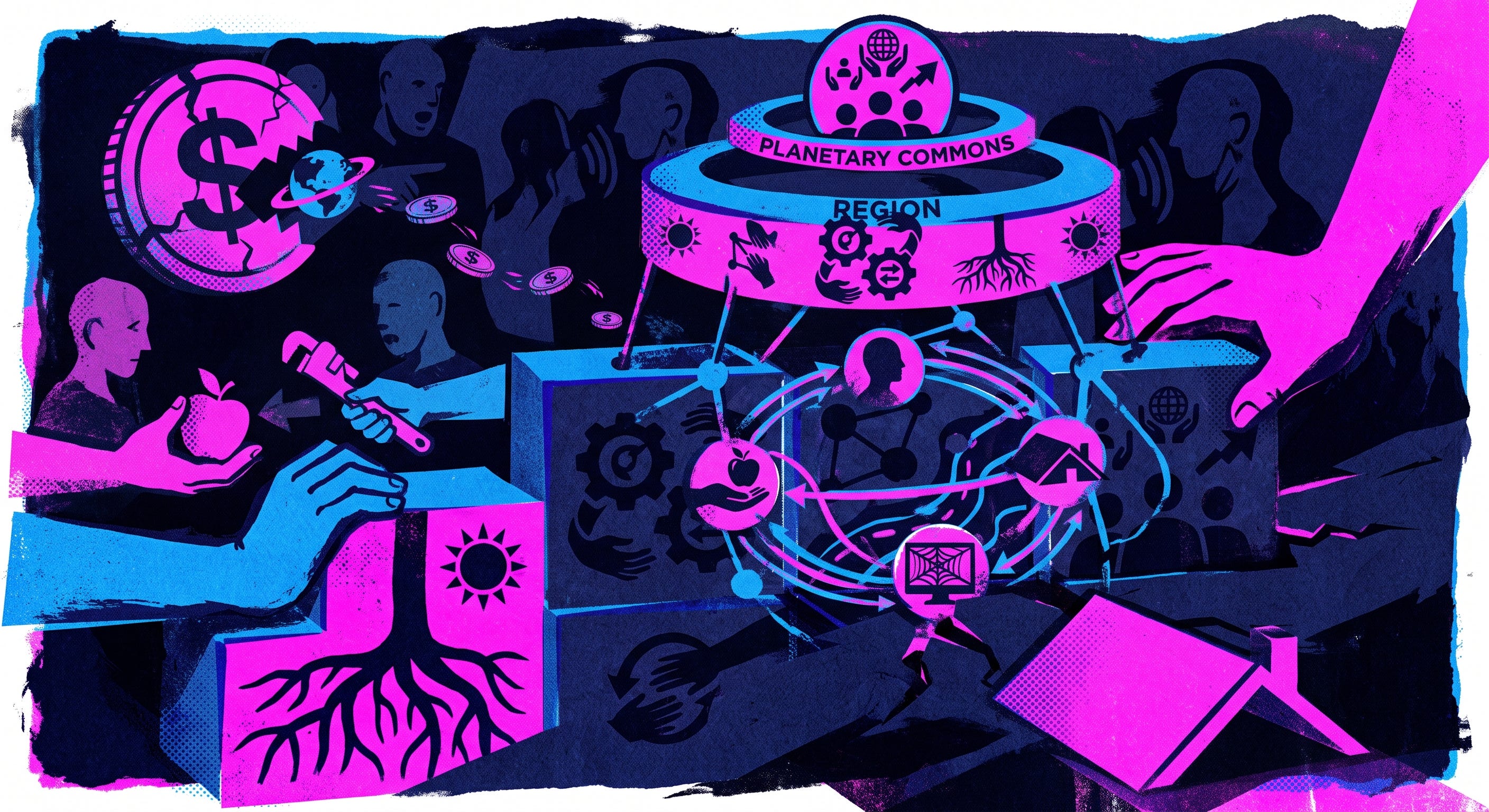
Your neighbour has apples. You have plumbing. She needs a roof. The roofer needs a website.
Four people, four surpluses, four needs. Nothing moves.
Not because anyone is greedy. Because nobody can see the cycle. Economists call it the double coincidence of wants, the oldest problem in the discipline: for a direct exchange to happen, i have to want what you have at the exact moment you want what i have. Which is almost never. So somewhere back there we invented a workaround. A token everybody would accept, so that nobody would have to find the cycle. We called it money.
It worked. It also became the thing.
As I wrote in “Composting Money”: money in its current form is a claim on lost life. We solved a matching problem by inventing a substance, then let the substance eat the planet. The token that was supposed to stand in for the cycle became the goal of every cycle, and the actual surpluses, the apples, the hours, the roof, became incidental to the movement of the pointer.
The mutual credit movement understood this early. LETS schemes, time banks, the WIR, the Chiemgauer, Sarafu in Kenya: for four decades communities have proved that you can keep trading when the money leaves town.
And every one of those ledgers hit the same wall. They were bilateral. You still had to find your match by hand. By our working estimate, pure barter cycles clear somewhere between a tenth and a quarter of what a network actually owes itself. The rest just sits there, willing and unmatched.
This was never a values problem. It’s a graph problem.
In 2007, Abraham, Blum and Sandholm published a paper titled, with no irony, “Clearing algorithms for barter exchange markets.” It describes integer-programming solvers that find cycles and chains of donors and patients that no pair could ever find alone. It is the mathematics the US national kidney exchange runs on. Operations research solved barter twenty years ago. It just did it for organs.
GUANXI takes that solver and points it at apples and roofs.
The protocol has no native currency. Not even one. Seven open layers instead: self-sovereign identity, a data vault you control, an open-weight agent that holds your intent profile and discloses it progressively, peer discovery, encrypted agent-to-agent negotiation, a deterministic clearing solver, and a cross-witnessed commitment log where humans sign the multilateral deals. No blockchain, no token to pump.
Your agent says: i can offer twelve hours of plumbing this month and i need roofing before the rains. The solver finds the seven-party cycle in which that closes. You sign and that’s it.
Two design choices carry the whole thing. First, tolerated imbalances: each community sets credit lines in its own unit, hours or a reference basket, so chains don’t have to close to zero at every hop. The second is decay. Balances rot in both directions, positive and negative, at a rate the community chooses. Money that decays if hoarded was a thought experiment in “Composting Money.” This is what it looks like when you stop imagining and write the rules file.
The solver is not neutral, and that’s the point
A market solver maximizes volume. This one doesn’t. Its objective function maximizes cleared value weighted by relationship continuity. A match that renews an exchange between people who have traded before outranks a marginally bigger one-off between strangers. It prefers cycles of two to four over long anonymous chains. Its success metric isn’t throughput. It’s the median number of exchanges per pair per year.
The introduction is the product. Hence the name: guanxi, the Chinese word for the web of people you can actually call on.
Exchanges are nested, local first. What the village can’t clear passes to the region. What the region can’t clear passes to the planetary commons. Readers of the WELTAUFGANG serial know the rule: separate by what scales, keep the binding in the near.
Governance is Ostrom, made machine-readable. Every clearing house publishes its rules and the solver applies them at clearing time. Credit limits and decay rates. Exclusion lists, so nobody in fossil extraction gets routed into your cycle, ever. Harvest rules, borrowed from indigenous practice: how much of a local capacity may be used, how much must stand for next year.
On paper. GUANXI exists today as a protocol specification and a proposal. Nobody’s tomatoes have cleared through it yet. I’ll report.
Because the hard layer isn’t one of the seven.
Everyone wants a village. Nobody wants to be a villager. That was the wall Jim Rutt and I hit in “The Bluefish Token,” and it is the wall this stack will hit on day one. A savings account feels safe because it owes you nothing personal. A decaying balance in a community ledger feels unsafe for the exact same reason: your security is now a list of names who owe you, and whom you owe.
Which is the older kind of security. The only kind that ever held.
Onboarding, then, is not a tutorial. You don’t explain the paradigm. You clear one cycle. Just the one. The plumber sees the roof appear and the apples leave and understands the whole architecture in an afternoon, in his body.
Money was a workaround for cycles we couldn’t see.
We can see them now.
Clear one.
Hello Thomas,
I see/read You thinking around something essential, which I have been thinking around almost daily since 2013 when I retired. Firs I was disgusted from what all was considered to be "money". Like a zoo with many different animals all labelled "money". No systematics recognizable. Then I started to look for something similar as the periodic system for the abundance of chemical elements. (Comming close.)
Thanks to archive.org and other sites I started to read, following cross-references in the books, findig things I wasnt searching for (bycatch).
("My") TwinToken is not money, but a type of information that is backed by services rendered in exchange for open payment. In other words, it is something that sellers and buyers can create by mutual agreement without needing a banking license. When this information is aggregated within a community and organized into a matrix, the sum of a participant’s columns shows what they owe the others in total, and the sum of the other participants’ columns shows what they owe the participant. If everyone places their debit balance in cash on a table, and those with a credit balance remove their balance from the table, the table will be empty again in the end and everything will be paid in full.
No need to search for circles. The graph and the matrix are the same, but different. The graph shows paths but no totals (Debit Credit). The Matrix shows no paths, but the totals and balances.
The graph for open payments is the same as the one with deliveries. Only the arrows are reversed.
Ref: Societary Circulation. Simon Newcomb (1885): "Principles of political economy", page 318.
A system of payment after clearing in the hands of the civil society, not in the backstores of banks. Not Money, but payment bottom up. As Stephen Colwell put it 1859: "The ways and means of payment a full analysis of the credit system, with its various modes of adjustment"
Not literally but short "Its payment, not money you fools")
If You are interested, I have collected more helping perspectives on "money".