

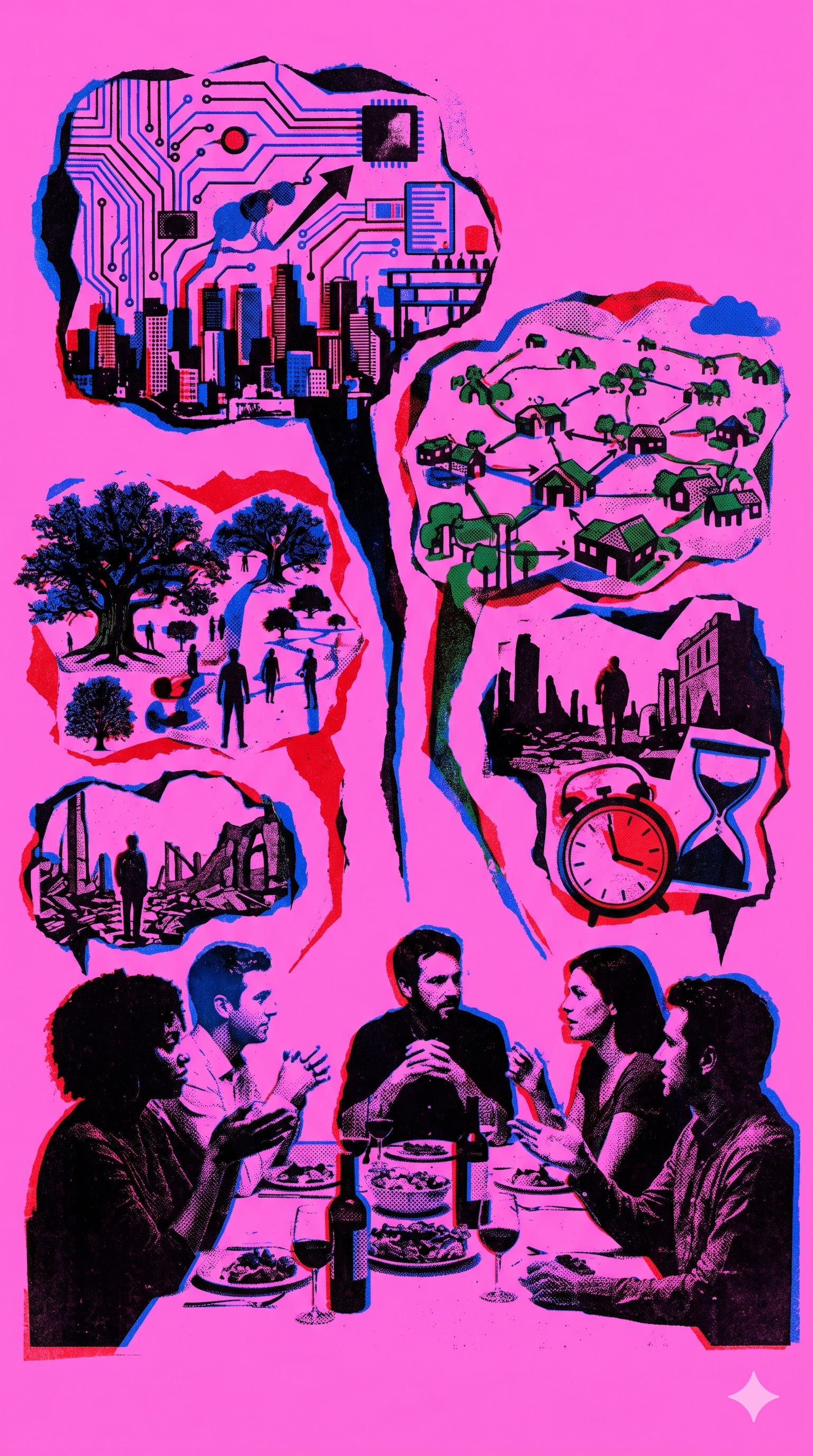
Five people are sitting at a table.
Each of them has spent the last decade working on what they would call, if pressed, the transition. They use slightly different vocabularies but they recognize each other. The conversation has been going for two hours and there has been a great deal of nodding. The dinner is excellent. The wine is open. They walk away from the table at midnight convinced there is alignment in the room.
None of them, in those two hours, has said a number.
I have been at that table many times. Sometimes I have been one of the people doing the nodding. Sometimes I have been the one who left feeling that something important did not get said.
Not because anyone in that room was hiding anything. Because the questions had not yet entered the room.
What did not get said is what I want to write about.
We talk as if we agree about the shape of the world we are trying to build. And in fact, surprisingly, we mostly do.
Walk into any room of serious people working on this. The metacrisis crowd. The Game B people. The bioregionalists. The cooperative economy people. The doughnut economists. The Indigenous futurists. The regenerative agriculture community. The commons scholars. The cosmo local builders. The four currency designers. The post growth thinkers. The Buen Vivir, sumak kawsay, ubuntu people.
The room has dozens of vocabularies. Underneath the vocabularies, the shape is the same.
Cooperation rather than extraction. Membranes rather than platforms. Bioregional rather than global. Plural rather than singular. Long rather than short. Care rather than capture. Many rather than one. The shape is so clear that anyone who has spent more than a year in any of these conversations could draw it on a napkin, and the other dozen vocabularies would recognize it without prompting.
The shape is not the disagreement.
The disagreement is the when.
And almost none of us sees that we need to say it out loud.
The AI accelerationist who came to your dinner party last month thinks the transition is fifteen years away. He thinks the substrate is about to flip, that the new economy will be running on agentic infrastructure by 2040, and that everything we are doing to prepare slow community fabric is either irrelevant or will be absorbed into the new substrate.
The Game B builder you met at the conference thinks the transition is fifty years. She thinks the cellular substrate has to be grown one viable community at a time, that the cold start problem is real, and that we are in year ten of a fifty year crossing.
The deep ecologist you keep reading thinks the transition is a hundred and fifty years. He thinks anything faster is hubris. He thinks the work right now is to protect what we can and to seed practices that will only fully mature in his grandchildren’s generation.
The despair positive thinker you keep almost arguing with thinks the transition is after collapse. She thinks no transition is possible until the existing system has actually fallen, that everything we build inside it gets captured by it, and that the real work is preparation for the rebuild.
The civilizational designer who wrote you that long email last week thinks the transition has already begun and that the window for the decisive moves is the next eight years.
These five people will sit at the same table and use the same words and nod at each other and walk away convinced that there is alignment.
There is no alignment.
There is alignment about the shape of the destination and total disagreement about the duration of the journey, and the disagreement about duration is the actual reason none of their projects fit together.
Because if you think it is fifteen years, you build differently. You bet on technology compounding. You underinvest in slow social fabric because the substrate change will outrun it. You make peace with capital.
If you think it is fifty years, you build communities and accords and currencies and you assume that the political layer is mostly downstream of the cultural layer and that the cultural layer takes generations to soften.
If you think it is a hundred and fifty years, you build seeds. You write the book. You plant the oak. You teach the apprentice who will teach the apprentice. You stop thinking about your own life as the unit and start thinking about lineages.
If you think it is after collapse, you build the seed bank, the monastery, the protocol that will be needed in the rebuild.
These are not the same project. They cannot share the same money. They cannot share the same staff. They cannot share the same urgency. They produce, when put in the same room, the maddening sense that everyone is talking past everyone else, even though everyone agrees about the shape.
But there is a second variable.
It diverges even more than the first. And we see it even less.
The second question is this. How many people do you expect to be alive at the end of your timeline?
Not how many you would want to be alive. Not how many you think should be alive. How many you actually, in the quiet of your own thinking, expect.
Twelve billion? Ten? Eight? Four? Two? One? Less?
Each of the five people at the table has a number for this too. The numbers are not in the same neighborhood. None of the five has been asked. Most of them have not yet asked themselves.
The AI accelerationist, if you asked him, would probably say twelve billion without much hesitation. Better medicine. Longer lives. Greater abundance. The projects he funds and the timelines he believes only make sense if he assumes most of humanity carries through. He just has not been asked.
The Game B builder expects something like eight billion. She thinks the transition is hard but survivable for most. Her communities are designed to absorb people, not to replace them. Her math assumes that the cooperative substrate, once built, can hold the species.
The deep ecologist has read the overshoot literature for thirty years. He cites carrying capacity numbers without flinching. He believes in a hundred and fifty year transition through climate disruption. The arithmetic is already in him. He has just never been invited to read out the sum, and so the sum has stayed in the margin of his thinking rather than the center.
The despair positive thinker may, if she sat with the question, name a number close to one billion. Her whole frame assumes collapse happens before transition begins, and collapse on the scale she expects is depopulating at scale. She has not, as far as I can tell, stated the population implication of her own framework. Almost nobody in her conversation has asked her to.
The civilizational designer expects something close to current population, maybe nine billion. Her decisive eight year window is, fundamentally, a bet that decisive action right now keeps the bottleneck from closing too hard. The number is doing all the work in her sense of urgency.
These are not the same expectations of the same future. And every project, every dollar, every life decision downstream of a population number is doing different work depending on what the number is.
If you expect twelve billion at the other end, you build for abundance and inclusion.
If you expect eight billion, you build for resilience under stress.
If you expect two billion, you have already, whether you have named it or not, accepted that something most of us would call a catastrophe is part of the path. You build for what survives it.
If you expect one billion, you are working on a different planet from the person who expects twelve, even if you use exactly the same words.
This is the second axis. Timeline and population. When and how many. The combination of the two creates the actual project a person is working on, no matter what the stated mission says.
Two people who agree on a fifty year timeline but disagree about whether eight billion or two billion are alive at the end are not doing the same work. They cannot be. The work the eight billion person is doing is transition. The work the two billion person is doing is triage with rebuild. These are different verbs.
And almost nobody has yet found a way to name which one.
These are not hidden questions. They are unseen questions. There is a difference. A hidden question is one you have refused to look at. An unseen question is one nobody has pointed at yet. Once it is pointed at, it cannot be unseen.
There is a discipline available to us, once we can see the questions, that we have not yet had a chance to use.
The discipline of saying our numbers.
Not the right numbers. There are no right numbers. Anyone who tells you they know how long the transition will take, or how many people will be alive at the end of it, is selling you something. But each of us, in the quiet of our own thinking, already operates on both. We have already decided. We have just not yet seen that we have.
The fifteen year, twelve billion person has decided. The fifty year, eight billion person has decided. The hundred and fifty year, two billion person has decided. They built their lives around the decisions. They chose where to live, what to study, what to fund, who to marry, what to have children for, around the decisions. The numbers are doing enormous work in each of their lives. They are doing it in a place nobody has yet thought to look.
So here is the modest proposal.
Before the next meeting where five aligned people talk past each other for two hours, name both questions out loud.
Not vaguely. Specifically.
How many years from today until the world we are trying to build is the world most people actually live in?
And how many people do we expect to be alive when we get there?
Write both numbers down. Have everyone else in the room write theirs down. Pass them around the table.
I have done this twice now. In both rooms the spread on the timeline was an order of magnitude. The spread on the population was an order of magnitude too. The people giving the answers had spent the previous two hours nodding at each other. None of them had been angry about the questions. Most of them had been a little surprised that the questions existed.
Once the numbers are on the table, the conversation about what to do this year changes shape. The fifteen year, twelve billion person and the hundred and fifty year, two billion person discover they cannot share the same calendar, the same hiring decisions, the same theory of how change happens, or the same definition of what counts as progress. They may still want to collaborate. They may even find places where their work braids. But the collaboration is now legible to itself. It knows what it is and what it is not.
This is what making a horizon explicit does. It allows the work of the year ahead to be done against it. The horizon is not flexible. The horizon is the discipline.
Most of us do not yet have a horizon. We have a vague sense, a sentiment, a felt slope. We have numbers we have never said out loud, never thought to say out loud, and would have to look at directly before we could state.
But we can, this week, look. And then ask each other.
Until we know whose clock each of us is on, and how many of us we each expect to make it through, we cannot help each other carry.
And what we have to carry will need to be carried for a long time.
Once I've decided on my number, can I call it Schindler's List? 😁
I completely agree that vocabulary convergence in the transition space is a challenge.
I also agree about the two variables, but I interpret them slightly differently. I'm curious to see how this lands for you...
To start, Meadows said (paraphrased) "the system determines behavior." The most ubiquitous system we all use today is money. So, (the design of) money determines behavior.
Second, Clare Graves laid out three possibilities for the species in a 1974 paper, "Human Nature Prepares for a Momentous Leap." To paraphrase him, the three are Termination, Technofeudalism, and Transcendence (he used slightly more complex terminology, so this is my interpretation).
Termination = everything collapses
Technofeudalism = top-down monetary reform: CBDCs, stablecoins, BIS digital settlement
Transcendence = bottom-up bioregional demurrage currencies, networked together
I argue that all three are likely, dependent on individual choice. In other words, some will choose Termination, others Technofeudalism, and a very small number will choose Transcendence.
My simple claim is that the (individual) outcome depends on something as simple as which monetary system the individual chooses to accept. There is no such thing as a collective outcome. So, the population number isn't so much about how many survive, but how many land up in each category. (I make this simple claim based on a deep study of evolutionary biology, human coordination, and evolution of consciousness.)
So the question I would put on the dinner-table napkin is slightly different, but it still addresses the two variables: What monetary substrate are you betting on, and have you looked at what is already waiting in the wings (GENIUS Act, etc.)?
Once that answer is on the table, the timeline (my guess is closer to 8 years) and the population numbers become easier to track.
FWIW, my completely unscientific guess based on 8bn over the next 8 years is:
Termination = 1.5bn
Technofeudalism = 6bn
Transcendence = 0.5bn
Unless of course the current trajectory significantly changes.
Finally, thank you for being the catalyst and providing the space to allow me to express, somewhat imperfectly I admit, something I have been circling for decades, and that has been increasingly coming into focus for me.
The truest expression of our values and intent is through our behaviour. Behaviours are the bedrock of culture. What an incredible opportunity this gives us.
With love, gratitude and respect 💖🙏